Bali
On our last night in Bangkok, Tina decided to play it safe and eat dinner in the Empress Hotel, rather than out on the streets. I had no appetite and was busy packing and preparing for our departure to Bali. Pad Thai noodles was her main course. In the middle of the night she was in the acute stages of food poisoning with all the expected symptoms. It was at this point that our large medical kit came to the rescue. We had a flight at 8:40am which we were not going to miss. Unable to hold anything on her stomach, she required something injectable. Check! Phenergan injectable. This got her to the airport though she continued to look like death warmed over. The flight was an agony but she made it alive. As we tried to disembark from the plane there was no hiding the fact from the stewardesses that Tina was acutely ill and a wheel chair was immediately brought up for our use. Then the real Red Carpet treatment began as a Thai Air employee personally escorted us through emigration and customs with no standing in line delays. At one point a suspicious customs official questioned whether Tina was really sick or trying to pull some sort of "fast one". But the Thai Air people stuck by us and took us by the hand as it were all the way to our taxi waiting for us. Our first stop in Bali was the Swastika hotel in Sanur and Tina's first stop was bed.
As we left the airport on our 25 minute drive to Sanur, we passed this massive, stunning sculpture in the center of the roadway round-about. It stood about 40 feet high and 60 feet in length. The theme, one repeated often in Bali, was of Hindu mythology.
Five days later, Sarah arrived in Bali on a flight from Brisbane. How wonderful it was to see her after her departure for Australia 4 months earlier. There were lots of hugs and kisses and then a beeline for the Bounty hotel on Kuta beach. The Bounty is rather famous as the young people's party hotel, most of whom are from Australia. We thought Sarah would like it, but she was ready for a nice, quiet beach. We asked some young people where the best snorkeling was and they recommended Nusa Lembongan, a small island off the east coast of Bali. So, off we went on a small, double outrigger boat. The crossing took maybe an hour and a half, and was made up of mostly young tourists from Europe and Australia. Nusa L. is also quite famous for its surfing off the encircling reef. This picture of Sarah, on the left, was taken from our hotel front steps. This hotel which fronted immediately upon the beach cost us a grand total of $6 per night (breakfast included). This was a wonderful opportunity to soak up the sun, stroll on the beach, snorkel and watch the local fisherman and seaweed farmers go about their business.
We went on two special snorkeling trips around the back side of the island, to a tiny island called Nusa Ceningan. The coral and marine life was just outstanding, and the water was crystal clear. Sarah and I went on a "drift" snorkel trip there, in 8 knot currents along sheer cliff. That was a challenge! We held hands and drifted along watching marine life and rock outcroppings whiz by.
Life on this tiny island is a blend of tourism and tradition. It has its challenges, one of which is salt water intrusion in the wells. So everyone bathes in salt water and drink only bottled water. The view in the early mornings was of the spectacular volcano Gunung Agung on Bali, across the bay.
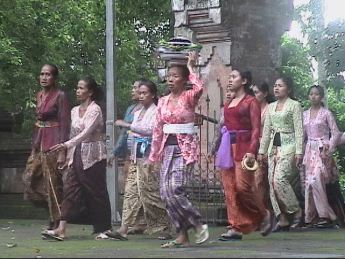
We quickly discovered in Bali that the Hindu culture is one of numerous ceremonies. These are occasions for the entire village to participate in and involve dressing up and bringing offerings to the temple. The priests say prayers, bless all the villagers and offerings are made to the various gods and ancestors. It seemed to us like there was a ceremony at one temple or another almost every day. Indeed, every village has multiple temples and every family also has a temple and ancestral shrines in its family compound. It is a daily duty for one of the woman in the family to lay offerings at various locations throughout the family compound as well as at whatever place of business they may have. Offerings are made to both the good spirits and the evil spirits since it is thought keeping both happy are essential to the family's well being. Misfortune in the family is generally explained as a form of retribution from the spirits for the misdeeds of family members. Another example which illustrates how many are the ceremonies is the first year of life for every child. No less than 6 different ceremonies are held from the time of conception till the first year of life (which is day 210 in the Balinese calendar). These ceremonies are for the purpose of ensuring a healthy baby, warding of sickness or disease which the spirits could bring upon them. The ceremony held on day 210 commemorates the First time the child is permitted to touch the ground. Until this time they are constantly held and carried about. We went to a number of these ceremonies, including one cremation ceremony.
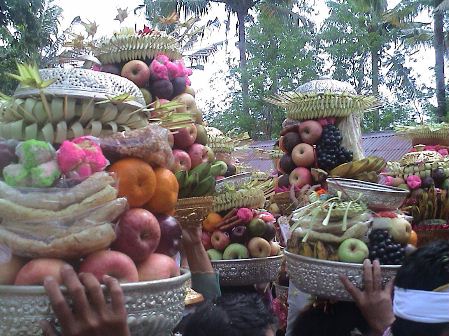
To the right are examples of the beautiful and tasty offerings that the women bring to the temple for the ceremonies. The more elaborate the ceremonies the more elaborate are the offerings. Women spend a considerable amount of their time preparing the offerings. At the end of the ceremony after the gods have taken due notice of the offerings which have been laid out before them the women pack them back up on their heads and bring them home to share with their families. At the ceremony where this photograph was taken there were literally one or two hundred offerings of this type and it was quite a sight watching a long line of women with these baskets on their heads streaming to and from the temple.
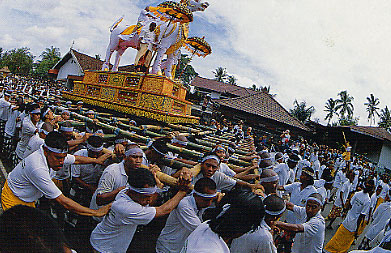
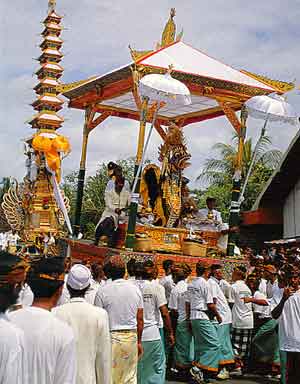
By far the largest ceremony we observed was the cremation ceremony for Ida Tjokorde Mengwi, one of the last kings in Bali. True kingdoms in Bali ended when Indonesia gained its independence from the Dutch in 1949. However, Ida Tjokorde did rule his kingdom prior to that, and was greatly renowned and respected. It was estimated that there were tens of thousands of visitors paying their respects the day of the ceremony, which was no doubt true. We couldn't get closer than half a block. We dressed in traditional clothing and joined the procession. The actual body is located in the tower, pictured at the left, just in front of where the two men are standing. Dozens of men carried this tower on their backs, spinning the tower in different directions to confuse and bewilder the evil spirits who might interfere with the departure of the King's spirit from this earth. The king's body was carried to the cemetery in the tower, then transferred to the white bull, pictured below on the left. The bull and king were then cremated, along with the naga banda, (mythical dragon), pictured on the right.The cremation itself cuts the earthly ties and sends the spirit on it's way to heaven.The next day the ashes from the corpse were taken to the sea to be united back with the elements. When the actual cremation was about to begin, everyone of lower caste, which was essentially the entire crowd, was expected to leave. We retreated with the crowd, grateful to have been able to see just a part of this magnificent ceremony.
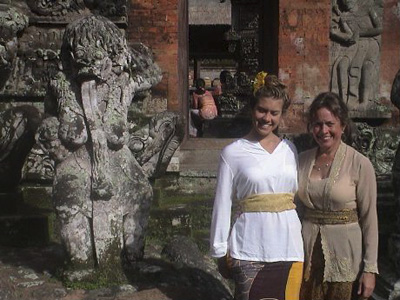
Mothers and daughters!
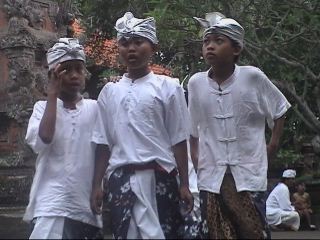
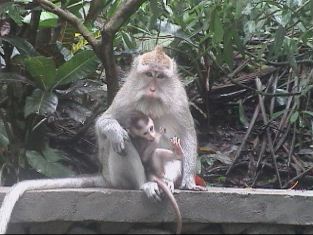
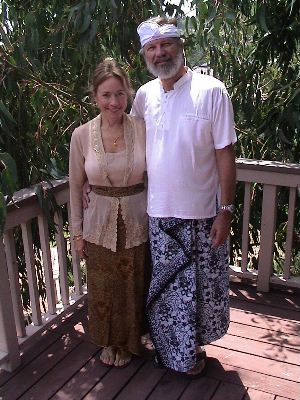
The monkey forest temple in Ubud was the location for these two pictures. We dressed in traditional clothes and were allowed to remain inside the compound during the 'blessing of the animals' ceremony. Other visitors, dressed more casually were escorted out. We were quite honored to be there and once again glad we made the effort to look our best at a ceremony. This is a gesture the Balinese really appreciate.

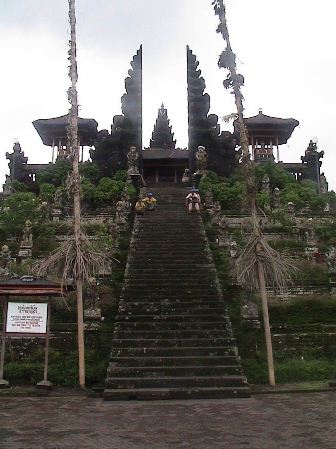
Besakih, the mother temple, is the most venerated in all of Bali. It is located on the slopes of Gunung Agung, the tallest active volcano on the island. The volcano's last eruption in 1963 killed 2000 people and destroyed the homes of 100,000. Some in Bali believe this eruption was the result of anger by the gods, perhaps because of the improper scheduling of the Eka Dasa Rudra ceremony. This is the greatest ritual in Balinese Hinduism, held once every 100 years for the spiritual purification of the island.
During our long stay in Bali, the majority of our time was spent in Ubud at this guest house on Monkey Forest Rd, called Sagittarius Inn. Every morning and evening offerings were meticulously made by a family member and placed at the family temple as well as at other locations inside the family compound. Behind this structure are the bungalows where we and other guests stayed. We would frequently wake early in the morning to the sounds of doves gently cooing and the smell of incense burning. This daily ritual had a soothing and spiritual quality that was to us a part of the essence of Bali. Beyond the chaos of Kuta beach and the hustle on the streets is a common union of souls steeped in ancient tradition with a loyalty to family and village. The Balinese are a gentle, serene people with a unique Hindu culture and rich heritage. It is amazing that being part of Indonesia, the largest Muslim country in the world, Bali is not only surviving but thriving. Bali was one of our favorite destinations.