Australia
December 19 was the first of our three big travel
days to journey from Bali to Brisbane and then to Heron Island, Australia.
Sarah was fortunate to have a direct red-eye from Bali to Brisbane and
friends to help with transportation and accommodations. We were not so
fortunate. Over a month earlier in Chiang Mai, Thailand we strolled into
a travel agency and found, to our horror that there there were no flights
available from Bali to Brisbane on that date. There were no flights available
for a good week or more either. We had a connecting flight from Brisbane
to Gladstone, and then our first ever helicopter ride to Heron Island all
in place, not to mention reservations for everyone to meet for Christmas.
Therefore we absolutely had to find a way to get to Brisbane by December
21. What we ended up with was a series of flights spanning half the globe,
it seemed. But we would make it to Heron Island if everything worked.
We left Bali and flew north to Bangkok, Thailand with a fair amount of concern,
as we had no visa to enter the country. When we arrived, we looked at each
immigration officer, trying to find the friendliest face. We had visions
of begging for permission to enter the country and having to check in with
main immigration office in downtown Bangkok. This could have sabotaged
our next flight the following day! So I found an officer who seemed to
smile a lot, and got in his line. Since I seemed to have an easier time
moving through immigration, Dale stood behind me as if we were not related.
After I was cleared to enter, I motioned that Dale was with me , and we sailed
on through the gate. That was a relief! We grabbed a taxi for the good 'ol
Empress Hotel and fell asleep by midnight. The next day we were on our way
to the airport again, this time for a very long flight all the way to the
southern Australian city of Melbourne. We were on a Qantas flight and the
first thing we noticed were metal knives on the meal trays. After the massive
security measures, seeing those knives was, well, pretty curious to say the
least. It also didn't help matters that there was a very frightening young
man sitting next to Dale. He was dark, unsmiling, nervous, and kept reading
the back of his airline ticket. He didn't eat, he didn't watch the movies,
he didn't talk. He kept reading that ticket until he became so tired he dosed
off. What should we do? Dale and I then quietly debated whether to tell the
stewardess. We decided to wait and keep observing him, but I can say I was
most nervous about this guy. He continued his behavior throughout the flight
but we safely landed and were very relieved to get off that plane. To this
day I wonder what was going on with him! We were on to a new challenge, however.
We had exactly one half hour to make it off the plane, race through immigration
and customs and get to a domestic gate on the opposite side of the airport.
This was a long shot! The first sprint was to the baggage carousel to see
hundreds of black bags. Bingo, yellow yarn tags. Those were ours. Quickly
we put on the backpacks, grabbed the wheeled bags and raced down to the huge
lines at immigration. Then it was on to customs. The line branched into two
lines, one for people with declared items and one for those with nothing
to declare. Here was a decision, what to do to make that flight. We did have
some wooden masks and little items from Bali. Would we get bogged down going
through everything in our bags? As we passed in our "things to declare" line
we were able to see past a privacy screen and saw some poor fellow in the
other line with his bags completely eviscerated. He was going to be there
for quite a while. What would we face behind our privacy screen? Our officer
wanted all of my bags on the counter. He asked what I had, and I started
to show him. After a few items, he said " Anything besides these kinds of
items?" I said no. He looked at Dale and Dale said he had basically the same
things. And with that, he said "Okay, next person in line". Whew, we were
in and out fast. We had 5 minutes left so we grabbed everything again and
ran like mad for the gate. In a full sweat, we were the last to board our
second Qantas red-eye flight, this time to Brisbane.
We arrived at the Brisbane airport and waited many, many hours to meet Sarah and then fly to Gladstone. While there, we were entertained by holiday caroling in a tropical setting which really helped soothe our growing fatigue. Here we were at last in a land of English speaking dairy consumers....almost like home! Finally Sarah arrived and shortly later we took off for Gladstone, a small town north on the coast. Our flight there was on a noisy little turbo prop, but we were entertained by a flight attendant with a gift for mimicry and theatric affect. I think it was the first time I ever saw a whole plane full of passengers actually listening to the safety instructions, because everyone was soon curious to see what her animated interpretations would be. After we landed at Gladstone and stored most of our bags to minimize our weight, we took off on a breathtaking flight in a helicopter. Our pilot pointed out all the highlights of the area and then out we flew over the Great Barrier Reef. We landed on the tiny Heron Island, a National Park within the Marine National park. It is a true tropical cay, surrounded by a pristine coral reef. The Heron Island Resort is the only accommodation on the island and is booked many months in advance. It was absolutely beautiful there, and the bird and marine life was equally impressive
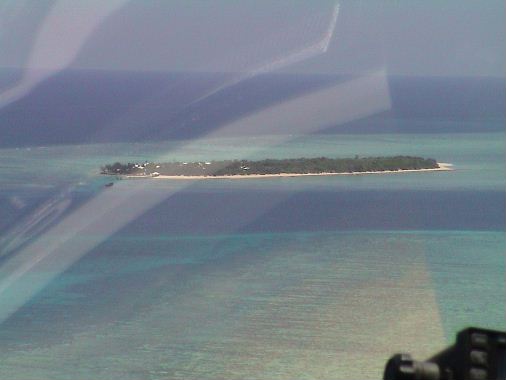
 Above is a picture of the island as we approached in the helicopter
. To the left is a picture of our family and long time friend Erik Papp,
who joined us. The swimming pool in the foreground is where we completed our
PADI Open Water certification so we could scuba dive with Daniel and Erik.
That opened a whole new world of under sea exploration for us. Daniel and
Erik saw a giant manta ray, and we all saw many reef sharks, fish of every
description, moray eels, and colorful corals and nudibranchs. We saw giant
sea turtles both in the water and on land. The island is a nesting ground
for both Green Leatherback and Ridley turtles and it was nesting
season. We took flashlights out to observe just after sunset and just before
dawn. They crawl up the beach to a location oriented by memory and scent
and spend the night digging a massive hole in which to lay up to one hundred
eggs. Before dawn the job is done and they crawl, utterly exhausted, back
to the sea. What a privilege it was to see these magnificent creatures.


The tip of Heron Island was a spot where you could sit all alone and look at a three hundred degree panorama of ocean, unobstructed. It seemed that you could see the curve of the earth out there, it was so crystal clear. Getting to the tip of the island required careful travel through the center of the island. There were Black Noddy Terns everywhere, on the ground sunning themselves, up in nests caring for their young, and zooming dangerously through the trees at about head level. In fact there were many species of birds congregating there. Eastern Reef Egrets (mistakenly identified as Herons years ago, hence the name of the island), Lesser Golden Plovers, Bar Shouldered Doves, Buff Banded Land Rails, Silver Eyes, Silver Gulls and Bar Tailed Godwits all spend time on the island. But the most entertaining of them all was the Wedge tailed Shearwater or Mutton Bird. Our first night there was our last night there without earplugs! Mutton Birds fighting over scarce nesting holes in the ground can roughly be described as sounding like asthmatic infants being brutally murdered. On our second night there we went out with flashlights and watched the Mutton Birds crash land on the island after a day of feeding at sea. Erik would yell " incoming flight" and we'd all duck and run as a large bird would weave through the trees and plow into the ground, with little apparent control. After the nest was found, usually already occupied, the arguing would start and last, off and on, throughout the night and end at dawn when the birds would leave to feed again. There was no television on the island, and who would need it with all this excitement at night!
 Our next stop was back to the mainland and on to greater Queensland.
We said good-bye to Erik and the four of us set off on a nine day tour.
We rented a car and headed north of Cairns to Mossman Gorge, famous for
its rain forest and pristine river. Just outside the park entrance to the
gorge was an aboriginal settlement with a gift shop. This is where we began
a tour and lecture with Guranji, a local aboriginal. We had been discouraged
about touring with an aboriginal by the local Australians, but found that
if you are patient with regards to time, its well worth the wait. Guranji
took us on a small walkabout and we saw how shelters were built and how the
people of the rain forest lived. He regaled us with stories from his own
life, growing up in Australia. He showed us the different plants that the
Aboriginals used from the rain forest. And, sadly, he told us about the
prejudice that has existed toward the aboriginals from the predominant white
population.
 We hiked for a couple hours with Guranji through the forest.
At one point we came to a rock near the river which demonstrated the different
colors of red and brown and orange ochres that the aboriginals could extract
rubbing different rocks together. They used these pigments for their art
and decorative work and the colors were truly stunning. We later saw many
examples of their drawings--using Aboriginal motifs. After our walk, Guranji
demonstrated playing a didgeradoo with great skill and let us all give it
a try. We made some pretty strange sounds and discovered that
playing a didgeradoo is very very difficult. We also learned
what an accomplished artist Guranji is and saw some of his work. We felt
very lucky to have shared this day with Guranji and to know so much more
about the Aboriginal way of life.
 It was always warm and we were always looking for a way to cool
off. The swimming area of the Mossman River was the most popular around
with crystal clear water, several sandy beaches and diving rocks. The small
fish there were entertaining to watch. They had adapted to humans in the
water and would swim quite close to you. They also liked being fed swatted
horseflies and would swarm and almost leap out of the water in a feeding
frenzy. On a tour of waterfalls in the area we found this spot where Daniel
and Sarah could cut loose. It was fun to watch those free spirits emerge.
One day we went on a long hike in a park forest. As time passed, the air got damp and heavy and it started to sprinkle. The few people we saw on the trail were quickly heading back for their cars, but we decided to finish the looping trail. We had two tiny umbrellas between the four of us and tried to share them as best we could. Soon the rain turned into a full tropical downpour and we found it impossible to stay dry. We covered the cameras and passports as best we could and surrendered to a complete soaking. At some points the rain came down so intensely it was impossible to see straight ahead with water running off your head into your eyes. We were laughing and splashing like four big kids as we finished our hike with the forest to ourselves. It was an unpredictably wonderful time.


The flora and fauna of Australia is many times unique, and we were on a quest to see as much diversity as possible. The strangler fig tree isn't unique to Australia but this particular one, unusual in shape and hundreds of years old, was aptly named The Curtain Fig. This area of Queensland, called the Tablelands because of its mesa-like formation, was home to the elusive, nocturnal platypus. We set out to see and photograph this shy monotreme with the dogged determination. Morning and night, with flashlights in hand, we hiked to streams and ponds only to see their dark shadows disappear after a few moments. That was disappointing, but we did see some other animals in the process, like tree kangaroos and owls. One predictable way to see wildlife of course, is in a zoo. Sarah is petting a wallaby, a smaller, less shy creature than the large red or gray kangaroos. We visited several small zoos and learned more about koalas and other animals native to Australia.


Only in Australia will you see caution signs like these. I have to say it was challenging for us driving there. You have to drive on the left, watch out for all kinds of wildlife and still try to sight see. We tended to drive slowly, which drove the locals crazy. They would zoom past us in complete frustration. So we drove as a team with one reading the maps, one on lookout for animals, roads and road rage, one keeping us on the LEFT, and one actually driving! Who would like to be at the wheel with this many back seat drivers? Amazingly, we were a successful team with plenty of kilometers covered and no accidents or fatalities.
On January 7th we were back in Cairns and sadly had to say good-bye to Daniel and Sarah. It was so wonderful to see them in the middle of our big trip and share some time together. They flew back to Brisbane and then on to the U.S. on separate flights the following day. Rejuvenated from our rendezvous with the family, off we went to Cape Tribulation.


The water looks nice, doesn't it? So clear, so warm, so.... deserted! Well, there is a good reason for no one being in the water. Swimming all along the Queensland coast in summer (October-April), is the deadly little box jellyfish. Australia looses tourists and daredevils every year to these creatures, which interestingly enough, inhabit the coast only, not the Great Barrier Reef.
Cape Tribulation is home to one of the few virgin wet tropical rain forests left on earth. By virgin, I mean that it has never been logged and is in pristine condition. In an effort to preserve the remaining forest, it has been designated as a Wet Tropics World Heritage Area. And it is magnificent. We hiked through the forest day and night with guides who pointed out all kinds of plants and animals we would never have noticed or identified. One of the first things we learned was to look out for the Gympie Gympie plant with its heart shaped leaves. They say it feels like needles of fiberglass if you brush against it, and the pain lasts a long, long time. Another plant, the lawyer vine, will hook you with its barbed vines. The cassowary bird can be dangerous because it will use its long sharp claws to kick and slice anything threatening its young. And we were warned not to swim in large rivers because of the mighty saltwater crocodile. So, we were careful! The birds of the forest created a symphony up in the canopy and we spent hours listening to them. I wish we would have bought a tape of their calls, they was so exquisite.
 This precious little bundle I am holding
is an orphaned baby fruit bat. We stopped at a small sanctuary along the
road called the Bat House, where volunteers care for the baby bats. We learned
that the fruit farmers consider them pests and kill the adults. Volunteers
save the few babies that they can. There is no rabies in Australia, so the
bats were perfectly safe to handle and they were as sweet, intelligent and
affectionate as they could be. They reminded me of curious little puppies
who wanted to be cuddled and petted, and would lick your fingers if they
smelled fruit. The younger bats are actually swaddled in tiny sheets to
simulate their mother's constant embrace in the wild. We stayed there for
an hour or more, feeding and holding these babies and when we tried to leave,
one of them flew to me, grabbed on and wouldn't let go. I almost had a new
pet!
The village of Daintree, along the mighty Daintree river, was our next stop. We stayed in a small trailer cabin, one of 6 , on a small family dairy farm which was walking distance to everything. Each morning we had fresh whole milk, as much as we wanted, and a panoramic view of the valley dotted with cows and migratory birds. At sunset, the sky became dark with thousands of fruit bats heading inland to feed. Their passing could take an hour or more as they followed the river on their journey. One morning we went on a bird watching boat trip with 8 very serious bird watchers and two expert guides. We saw or heard dozens of migratory as well as indigenous birds as we moved along the tributaries of the Daintree River. Species like the Papuan Frogmouth, Laughing Kookaburra, Sulpher-Crested Cockatoo and Royal Spoonbill dazzled us that early morning. We even saw a young saltwater crocodile, unusual for that time of year. Daintree was a pastoral setting where we could have happily lingered quite a while.
On January 15 we were back in Brisbane and had one day left before the next part of our journey. We decided to visit the Australia Zoo, made famous by Steve Irwin the "crocodile hunter" on TV. About an hour north of the city, it was a delightful experience with knowledgeable, enthusiastic guides, healthy animals and even the entire Irwin family there to share their love of animals. Steve was as passionate and theatrical in person as he is on TV, and has quite a following, especially among the tourists. Their 5 year old daughter Bindi was playing with the baby goats in the petting zoo section, oblivious to the tourists watching her and clearly already has a way with animals. What a magical environment for a child to grow up in.
Our last 9 days in Australia were spent traveling down the coast to Sydney. We booked an open ticket on a bus so we could stop where we liked. After some research on Dale's part, we decided to spend a few days at Byron Bay and do some scuba diving. This area is a favorite vacation spot for the locals as well as tourists. It's far enough south that there are no box jellyfish to worry about and the diving was outstanding with the clearest water we experienced in Australia. We took a dive boat out to a tiny rock island and saw many large stingrays, swarms of schooling fish, many multi-colored nudibranchs, and the visibility was breathtakingly clear. Our dive master for the day was as impressed as we were and told us that on every dive he made he was always seeing things he'd never seen before. This was the kind of discovery we were into.
Our last stop was Sydney, where we rolled into town about 11pm. We had reservations at the Virgin Backpackers Hostel, which was a primitive but friendly shelter in the Kings Cross section of the city. In the morning we had a complimentary cereal breakfast and chatted with some of the young people staying there. As usual, they were from all over the world, and had their share of stories to tell. We heard that travel to the eastern islands of Indonesia (Nusa Tenggara) seemed safe, which was very good to hear. We had to make a decision about where to travel our last two months in Asia.


The Sydney Aquarium was without a doubt, the most breathtaking aquarium we have ever seen. Here was a very large platypus display, designed to turn day into night so all could see this nocturnal animal swimming and feeding. There were several large tanks with glass tunnels through them where you could see all types of sharks, rays, turtles and schools of fish, from the bottom or the top. Small tanks had brilliant reef fish, jellies, and nudibranchs. It was located on Sydney Harbour, a great central location. A word of advice, you can skip the Sydney Zoo....
After a few days at the Virgin, we decided to splurge and stay around the corner at the Kingsview Hotel, complete with a functioning bathtub! One night we went out to film the colorful nightlife on the street. Two young men suddenly ran up and demanded our film and camera. We were shocked and in a split second of analysis decided to say no to them. There were plenty of people around, and a police station was at the end of the block, so we held our ground. They came at us, yelling in our faces to give them the camera and I just stood there and yelled back at them. One man left, but the other was still at it. I started to get more nervous and Dale was across the street, so I waited until a slow moving car was about to pass, and ran across the street just in front of it so this character couldn't follow me. The yelling and demands continued as a stream of cars passed, but we popped into our hotel, which brought an end to it all. It was a shocking experience and I asked the hotel clerk his opinion of what had happened. He said we were filming in an area where illegal activities were happening and we no doubt caught them on film. He also said these immigrants were constantly fighting either the locals or each other. In the safety of our room we watched our film and sure enough, there were our two would-be muggers coming at us, yelling. Nothing else looked bad on the film however, so who knows why these guys wanted our camera.
January 26 was our last day in Sydney and it also happened to be Australia Day, a day of great national celebration and pride. The city was packed with people. There was a fear of terrorism, but aside from seeing an agent filming some Indonesian tourists, thankfully nothing happened. The journey through eastern Australia was just wonderful, everything we thought it would be and more.
And so it was on to our next stop, Singapore.
We arrived at the Brisbane airport and waited many, many hours to meet Sarah and then fly to Gladstone. While there, we were entertained by holiday caroling in a tropical setting which really helped soothe our growing fatigue. Here we were at last in a land of English speaking dairy consumers....almost like home! Finally Sarah arrived and shortly later we took off for Gladstone, a small town north on the coast. Our flight there was on a noisy little turbo prop, but we were entertained by a flight attendant with a gift for mimicry and theatric affect. I think it was the first time I ever saw a whole plane full of passengers actually listening to the safety instructions, because everyone was soon curious to see what her animated interpretations would be. After we landed at Gladstone and stored most of our bags to minimize our weight, we took off on a breathtaking flight in a helicopter. Our pilot pointed out all the highlights of the area and then out we flew over the Great Barrier Reef. We landed on the tiny Heron Island, a National Park within the Marine National park. It is a true tropical cay, surrounded by a pristine coral reef. The Heron Island Resort is the only accommodation on the island and is booked many months in advance. It was absolutely beautiful there, and the bird and marine life was equally impressive
Above is a picture of the island as we approached in the helicopter
. To the left is a picture of our family and long time friend Erik Papp,
who joined us. The swimming pool in the foreground is where we completed our
PADI Open Water certification so we could scuba dive with Daniel and Erik.
That opened a whole new world of under sea exploration for us. Daniel and
Erik saw a giant manta ray, and we all saw many reef sharks, fish of every
description, moray eels, and colorful corals and nudibranchs. We saw giant
sea turtles both in the water and on land. The island is a nesting ground
for both Green Leatherback and Ridley turtles and it was nesting
season. We took flashlights out to observe just after sunset and just before
dawn. They crawl up the beach to a location oriented by memory and scent
and spend the night digging a massive hole in which to lay up to one hundred
eggs. Before dawn the job is done and they crawl, utterly exhausted, back
to the sea. What a privilege it was to see these magnificent creatures.
The tip of Heron Island was a spot where you could sit all alone and look at a three hundred degree panorama of ocean, unobstructed. It seemed that you could see the curve of the earth out there, it was so crystal clear. Getting to the tip of the island required careful travel through the center of the island. There were Black Noddy Terns everywhere, on the ground sunning themselves, up in nests caring for their young, and zooming dangerously through the trees at about head level. In fact there were many species of birds congregating there. Eastern Reef Egrets (mistakenly identified as Herons years ago, hence the name of the island), Lesser Golden Plovers, Bar Shouldered Doves, Buff Banded Land Rails, Silver Eyes, Silver Gulls and Bar Tailed Godwits all spend time on the island. But the most entertaining of them all was the Wedge tailed Shearwater or Mutton Bird. Our first night there was our last night there without earplugs! Mutton Birds fighting over scarce nesting holes in the ground can roughly be described as sounding like asthmatic infants being brutally murdered. On our second night there we went out with flashlights and watched the Mutton Birds crash land on the island after a day of feeding at sea. Erik would yell " incoming flight" and we'd all duck and run as a large bird would weave through the trees and plow into the ground, with little apparent control. After the nest was found, usually already occupied, the arguing would start and last, off and on, throughout the night and end at dawn when the birds would leave to feed again. There was no television on the island, and who would need it with all this excitement at night!
Our next stop was back to the mainland and on to greater Queensland.
We said good-bye to Erik and the four of us set off on a nine day tour.
We rented a car and headed north of Cairns to Mossman Gorge, famous for
its rain forest and pristine river. Just outside the park entrance to the
gorge was an aboriginal settlement with a gift shop. This is where we began
a tour and lecture with Guranji, a local aboriginal. We had been discouraged
about touring with an aboriginal by the local Australians, but found that
if you are patient with regards to time, its well worth the wait. Guranji
took us on a small walkabout and we saw how shelters were built and how the
people of the rain forest lived. He regaled us with stories from his own
life, growing up in Australia. He showed us the different plants that the
Aboriginals used from the rain forest. And, sadly, he told us about the
prejudice that has existed toward the aboriginals from the predominant white
population.
We hiked for a couple hours with Guranji through the forest.
At one point we came to a rock near the river which demonstrated the different
colors of red and brown and orange ochres that the aboriginals could extract
rubbing different rocks together. They used these pigments for their art
and decorative work and the colors were truly stunning. We later saw many
examples of their drawings--using Aboriginal motifs. After our walk, Guranji
demonstrated playing a didgeradoo with great skill and let us all give it
a try. We made some pretty strange sounds and discovered that
playing a didgeradoo is very very difficult. We also learned
what an accomplished artist Guranji is and saw some of his work. We felt
very lucky to have shared this day with Guranji and to know so much more
about the Aboriginal way of life.
It was always warm and we were always looking for a way to cool
off. The swimming area of the Mossman River was the most popular around
with crystal clear water, several sandy beaches and diving rocks. The small
fish there were entertaining to watch. They had adapted to humans in the
water and would swim quite close to you. They also liked being fed swatted
horseflies and would swarm and almost leap out of the water in a feeding
frenzy. On a tour of waterfalls in the area we found this spot where Daniel
and Sarah could cut loose. It was fun to watch those free spirits emerge.One day we went on a long hike in a park forest. As time passed, the air got damp and heavy and it started to sprinkle. The few people we saw on the trail were quickly heading back for their cars, but we decided to finish the looping trail. We had two tiny umbrellas between the four of us and tried to share them as best we could. Soon the rain turned into a full tropical downpour and we found it impossible to stay dry. We covered the cameras and passports as best we could and surrendered to a complete soaking. At some points the rain came down so intensely it was impossible to see straight ahead with water running off your head into your eyes. We were laughing and splashing like four big kids as we finished our hike with the forest to ourselves. It was an unpredictably wonderful time.
The flora and fauna of Australia is many times unique, and we were on a quest to see as much diversity as possible. The strangler fig tree isn't unique to Australia but this particular one, unusual in shape and hundreds of years old, was aptly named The Curtain Fig. This area of Queensland, called the Tablelands because of its mesa-like formation, was home to the elusive, nocturnal platypus. We set out to see and photograph this shy monotreme with the dogged determination. Morning and night, with flashlights in hand, we hiked to streams and ponds only to see their dark shadows disappear after a few moments. That was disappointing, but we did see some other animals in the process, like tree kangaroos and owls. One predictable way to see wildlife of course, is in a zoo. Sarah is petting a wallaby, a smaller, less shy creature than the large red or gray kangaroos. We visited several small zoos and learned more about koalas and other animals native to Australia.
Did you know that koalas should be picked up by their arms and not as we would with human babies? ( Their ribs are so weak and fragile that they break very easily) And the cassowary bird, which is a principal player in the reforestation of the tropical forest, is incubated and cared for only by the male of the species! Sadly, they are very endangered, not from poor parenting, but low reproductive rates, loss of habitat and fatal encounters with cars and domestic animals.
Only in Australia will you see caution signs like these. I have to say it was challenging for us driving there. You have to drive on the left, watch out for all kinds of wildlife and still try to sight see. We tended to drive slowly, which drove the locals crazy. They would zoom past us in complete frustration. So we drove as a team with one reading the maps, one on lookout for animals, roads and road rage, one keeping us on the LEFT, and one actually driving! Who would like to be at the wheel with this many back seat drivers? Amazingly, we were a successful team with plenty of kilometers covered and no accidents or fatalities.
On January 7th we were back in Cairns and sadly had to say good-bye to Daniel and Sarah. It was so wonderful to see them in the middle of our big trip and share some time together. They flew back to Brisbane and then on to the U.S. on separate flights the following day. Rejuvenated from our rendezvous with the family, off we went to Cape Tribulation.
The water looks nice, doesn't it? So clear, so warm, so.... deserted! Well, there is a good reason for no one being in the water. Swimming all along the Queensland coast in summer (October-April), is the deadly little box jellyfish. Australia looses tourists and daredevils every year to these creatures, which interestingly enough, inhabit the coast only, not the Great Barrier Reef.
Cape Tribulation is home to one of the few virgin wet tropical rain forests left on earth. By virgin, I mean that it has never been logged and is in pristine condition. In an effort to preserve the remaining forest, it has been designated as a Wet Tropics World Heritage Area. And it is magnificent. We hiked through the forest day and night with guides who pointed out all kinds of plants and animals we would never have noticed or identified. One of the first things we learned was to look out for the Gympie Gympie plant with its heart shaped leaves. They say it feels like needles of fiberglass if you brush against it, and the pain lasts a long, long time. Another plant, the lawyer vine, will hook you with its barbed vines. The cassowary bird can be dangerous because it will use its long sharp claws to kick and slice anything threatening its young. And we were warned not to swim in large rivers because of the mighty saltwater crocodile. So, we were careful! The birds of the forest created a symphony up in the canopy and we spent hours listening to them. I wish we would have bought a tape of their calls, they was so exquisite.
This precious little bundle I am holding
is an orphaned baby fruit bat. We stopped at a small sanctuary along the
road called the Bat House, where volunteers care for the baby bats. We learned
that the fruit farmers consider them pests and kill the adults. Volunteers
save the few babies that they can. There is no rabies in Australia, so the
bats were perfectly safe to handle and they were as sweet, intelligent and
affectionate as they could be. They reminded me of curious little puppies
who wanted to be cuddled and petted, and would lick your fingers if they
smelled fruit. The younger bats are actually swaddled in tiny sheets to
simulate their mother's constant embrace in the wild. We stayed there for
an hour or more, feeding and holding these babies and when we tried to leave,
one of them flew to me, grabbed on and wouldn't let go. I almost had a new
pet!The village of Daintree, along the mighty Daintree river, was our next stop. We stayed in a small trailer cabin, one of 6 , on a small family dairy farm which was walking distance to everything. Each morning we had fresh whole milk, as much as we wanted, and a panoramic view of the valley dotted with cows and migratory birds. At sunset, the sky became dark with thousands of fruit bats heading inland to feed. Their passing could take an hour or more as they followed the river on their journey. One morning we went on a bird watching boat trip with 8 very serious bird watchers and two expert guides. We saw or heard dozens of migratory as well as indigenous birds as we moved along the tributaries of the Daintree River. Species like the Papuan Frogmouth, Laughing Kookaburra, Sulpher-Crested Cockatoo and Royal Spoonbill dazzled us that early morning. We even saw a young saltwater crocodile, unusual for that time of year. Daintree was a pastoral setting where we could have happily lingered quite a while.
On January 15 we were back in Brisbane and had one day left before the next part of our journey. We decided to visit the Australia Zoo, made famous by Steve Irwin the "crocodile hunter" on TV. About an hour north of the city, it was a delightful experience with knowledgeable, enthusiastic guides, healthy animals and even the entire Irwin family there to share their love of animals. Steve was as passionate and theatrical in person as he is on TV, and has quite a following, especially among the tourists. Their 5 year old daughter Bindi was playing with the baby goats in the petting zoo section, oblivious to the tourists watching her and clearly already has a way with animals. What a magical environment for a child to grow up in.
Our last 9 days in Australia were spent traveling down the coast to Sydney. We booked an open ticket on a bus so we could stop where we liked. After some research on Dale's part, we decided to spend a few days at Byron Bay and do some scuba diving. This area is a favorite vacation spot for the locals as well as tourists. It's far enough south that there are no box jellyfish to worry about and the diving was outstanding with the clearest water we experienced in Australia. We took a dive boat out to a tiny rock island and saw many large stingrays, swarms of schooling fish, many multi-colored nudibranchs, and the visibility was breathtakingly clear. Our dive master for the day was as impressed as we were and told us that on every dive he made he was always seeing things he'd never seen before. This was the kind of discovery we were into.
Our last stop was Sydney, where we rolled into town about 11pm. We had reservations at the Virgin Backpackers Hostel, which was a primitive but friendly shelter in the Kings Cross section of the city. In the morning we had a complimentary cereal breakfast and chatted with some of the young people staying there. As usual, they were from all over the world, and had their share of stories to tell. We heard that travel to the eastern islands of Indonesia (Nusa Tenggara) seemed safe, which was very good to hear. We had to make a decision about where to travel our last two months in Asia.
The Sydney Aquarium was without a doubt, the most breathtaking aquarium we have ever seen. Here was a very large platypus display, designed to turn day into night so all could see this nocturnal animal swimming and feeding. There were several large tanks with glass tunnels through them where you could see all types of sharks, rays, turtles and schools of fish, from the bottom or the top. Small tanks had brilliant reef fish, jellies, and nudibranchs. It was located on Sydney Harbour, a great central location. A word of advice, you can skip the Sydney Zoo....
After a few days at the Virgin, we decided to splurge and stay around the corner at the Kingsview Hotel, complete with a functioning bathtub! One night we went out to film the colorful nightlife on the street. Two young men suddenly ran up and demanded our film and camera. We were shocked and in a split second of analysis decided to say no to them. There were plenty of people around, and a police station was at the end of the block, so we held our ground. They came at us, yelling in our faces to give them the camera and I just stood there and yelled back at them. One man left, but the other was still at it. I started to get more nervous and Dale was across the street, so I waited until a slow moving car was about to pass, and ran across the street just in front of it so this character couldn't follow me. The yelling and demands continued as a stream of cars passed, but we popped into our hotel, which brought an end to it all. It was a shocking experience and I asked the hotel clerk his opinion of what had happened. He said we were filming in an area where illegal activities were happening and we no doubt caught them on film. He also said these immigrants were constantly fighting either the locals or each other. In the safety of our room we watched our film and sure enough, there were our two would-be muggers coming at us, yelling. Nothing else looked bad on the film however, so who knows why these guys wanted our camera.
January 26 was our last day in Sydney and it also happened to be Australia Day, a day of great national celebration and pride. The city was packed with people. There was a fear of terrorism, but aside from seeing an agent filming some Indonesian tourists, thankfully nothing happened. The journey through eastern Australia was just wonderful, everything we thought it would be and more.
And so it was on to our next stop, Singapore.