Vietnam
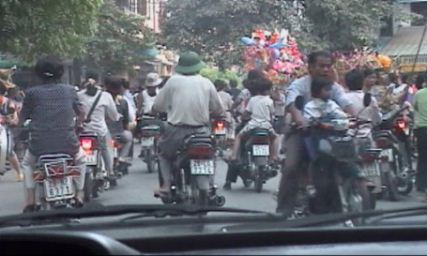
The first impressions as we drove into Hanoi from the airport
in a taxi was of the miles and miles of rice fields filled with human labor
and water buffalo. It seemed a huge and industrious population was hard
at work on these fields, cultivating and harvesting and nowhere did we
see any machinery other than water buffalo and plows. The next impression
we had as we entered the outskirts of Hanoi was the tremendous number of
bicycles and motorbikes and relatively ordered chaos in the streets. While
there were lines in the middle of the road, presumably separating lanes,
no one paid them much attention. They appeared to be only recommendations
for you could drive on either side of the street and most people did, depending
on the traffic. Vehicles were about evenly divided between bicycles and
motorbikes with a sprinkling of cars (mostly taxis) There were very few
traffic lights so coming to intersections was a real sight as people slowed
down and weaved between the crossing traffic. We saw entire families
of 4 and 5 people on these motor bikes with the littlest children squeezed
between the adults. There were motor bikes with live pigs strapped on the
back, and baskets full of chickens, ducks, and even puppies! All were going
to market. In all the time we were in Vietnam, I saw only 1 slight collision
which was not even enough for the two people to bother stopping to discuss
it. We also saw very few police and presumed that traffic citations were
unheard of.
Our first day in Vietnam was an intense overload of emotional experience.
We were trying out for the first time our plan to arrive in each location
without reservations and we were feeling some insecurity as we got to our
hotel which was in a very busy and central part of Hanoi, down a narrow,
highly congested street, filled with motorbikes, cyclos (three wheeled bicycles)
and pedestrians. Our street had numerous bars and eateries, art galleries,
CD shops and even a couple of internet cafes. Arising from the taxi and
bounding into the hotel to find out if they had a room we were, in a flash,
moving into our room which was large, with lots of windows
and light and a balcony overlooking the street. But within a few minutes
our excitement turned to dismay as we realized one of our bags was missing--the
bag that contained ALL of our guidebooks.
This was a crises!!
We thought of everything--had the taxi driver mistakenly left it in the
trunk of his taxi? Had he or someone on the street stolen it in the midst
of the confusion of getting our bags in the hotel? Had we left it at the
airport? The least likely scenario, we thought. With this bit of bad news
we decided to change the subject and take a walk around the neighborhood
and see the lake which was but a block away. We were immediately accosted
by numerous youngsters--hawking postcards and books to any willing tourist.
Some were polite and some were quite pushy and insistent. After parting
with quite a few dollars and discovering that the more we bought, the more
hawkers we were attracting, Tina had the flash of insight to get into a cyclo
to get away. It worked. Later we met another lad, selling postcards and
books whom we declined to buy from but offered to buy him a dinner . This
was an opportunity to communicate as best we could and learn what we could
about life on the streets for these youngsters. It seemed they all had unhappy
stories of poverty--some without families, some having moved to Hanoi from
the countryside to try to earn money.
In this lad's case, he
was 18, hoping to earn enough money to go to a cooking school and was all
alone in Hanoi, having come here from the countryside. Rudimentary English
is the second language of these street hawkers. Some of the best English
we heard in Hanoi were from youngsters learning it on the street as a means
to an end of selling this or that tourist item. We told him of our plight
and he had a solution. He told us he could get us illegal copies of Lonely
Planet Guides. We were incredulous! But he told us to wait and within
5 minutes he returned with perfect copies of the guides we had just lost,
brand new and looking like the original thing and cheaper than US prices.
We were still holding out hope that perhaps the bag would be found at the
airport so we promised we would let him know the next evening if we would
need his books. He was very excited and was counting already on a big sale!!
Well, the following day we called the airport and were excited to learn
that indeed our bag was there. Another $16 round-trip by taxi later and
we had our bag. As for the young lad who lost the sale, Tina agreed to
buy a cook book from him of Vietnamese dishes which was a consolation prize.
This was the first thing we had lost and then found and we found this to
become a recurring story--some item temporarily lost, misplaced or mis-packed.
But with unerring consistency, we found that every item we were convinced
had been lost later turned up somewhere in our belongings. The only thing
that we left by accident back in California was my mask and snorkel.
During the 2 plus weeks we stayed in Hanoi and the surrounding
area, we came to know the hotel staff at the Win Hotel quite well. And they
took very good care of us. Every morning, we would call down to order our
breakfast which would be delivered to our room or taken in the lobby as we
pleased. The standard western breakfast all over Vietnam is choice of fried
eggs, omelet or banana pancake served with baguette and choice of butter or
jam with coffee or juice. We saw this menu everywhere!! Jam was not always
available. In the afternoons when we straggled into the hotel, the staff
would prepare some kind of fruit plate and juice for us and they were always
eager to practice their English. We learned that two of the staff were recent
college graduates and had been at this job for less than a year. Lam was
a linguistics major and told us only 30% of college graduates find work in
their field of study. Unemployment is high. Wages are low. He was earning
$50 per month, working 7 days a week and had only 2 days off since he started
this job. The average age of the Vietnamese appeared very low--the streets
filled with people who appeared 25 or younger. They didn't project any hostility
toward Americans--too young to have any direct experience with the war and
what we found over and over was curiosity and interest. Of course, there
is the obvious and natural interest in having us part with money. The streets
of Vietnam are filled with entrepreneurs, not communists. It seems almost
everyone is operating some kind of small enterprise from their front porch.
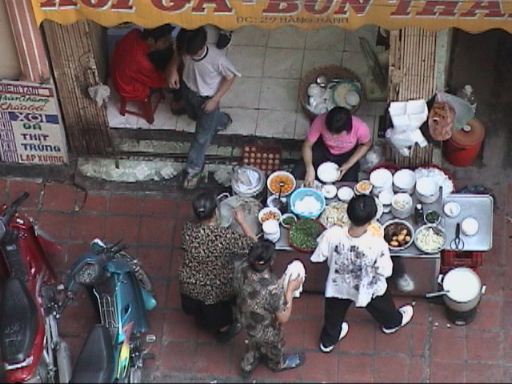 This was the view from our balcony every morning. A small noodle and
rice shop that served breakfast to hordes of young people who drove up and
parked their motorbikes. They had a special person designated to keep all
the motor bikes parked neatly and tightly together. The proprietress, in
pink blouse, is seated at her stool with a full array of ingredients and
flavorings to add to the bowls of rice or noodles and she prepares to your
order. The most traditional and commonly ordered breakfast was pho ga, which
was a chicken noodle soup made with rice noodles. She was virtually a one
woman show, preparing your food with her hands and collecting your money.
After collecting your bowl of soup you would step inside to sit on very low
stools and sit at equally low tables.
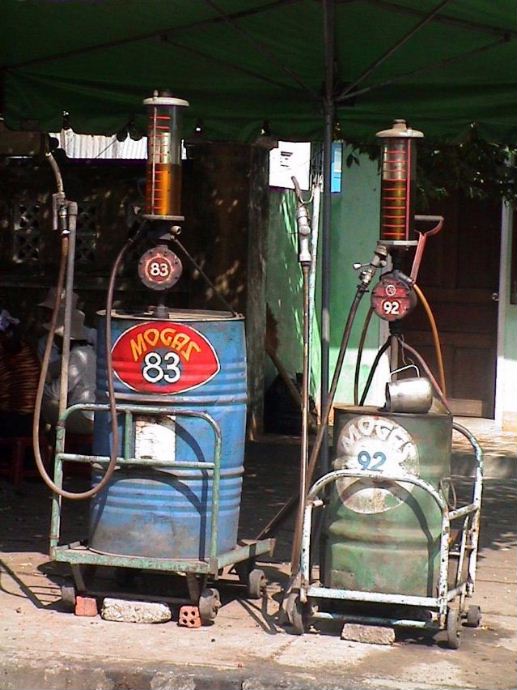 Because motorbikes were the most common motorized form of transportation
and the amount of gasoline needed was small, setting up your own gas station
was a very common business and we saw lots of these, set up in front of a
small mom and pop business selling sodas or snacks. Two different octane
ratings. A pattern we noticed again and again was the concentration of like
minded businesses in a certain section of town. E.g. furniture, books, CD
music, clothing, electronics. You would see store after store, selling virtually
the same merchandise, with little to distinguish store A from store B from
store Z. This might even be duplicated in street side stands, one after
another selling the same items. When we got to Saigon we saw the local cyclo
overnight parking lot right across from our balcony. When the last cyclo
rider had gone home there were all the cyclo drivers, sleeping in their cyclos
till dawn, parked on a sidewalk or corner. We were told that these were
the men from outside of town who had no other place to live or store their
most prized possession and means of livelihood. It was clear to us that for
many eking out a livelihood was a real struggle. With no public toilet facilities
and literally thousands of people living on the streets of Saigon it was
something of a problem and we saw many examples of men relieving themselves
on the streets. We didn't see this in Hanoi though we did see plenty of
poverty. On our wanderings we saw the massive Ho Chi Minh mausoleum. Inside
and against his wishes, is "Uncle Ho's" body on display. He is still considered
the father of Vietnam, loved by all, and his picture hangs in virtually
every home and business. By nature, he was a modest man, refusing to live
in the existing presidential palace, and instead built himself a small raised
house on the grounds. He never married and considered all Vietnamese to
be his children.
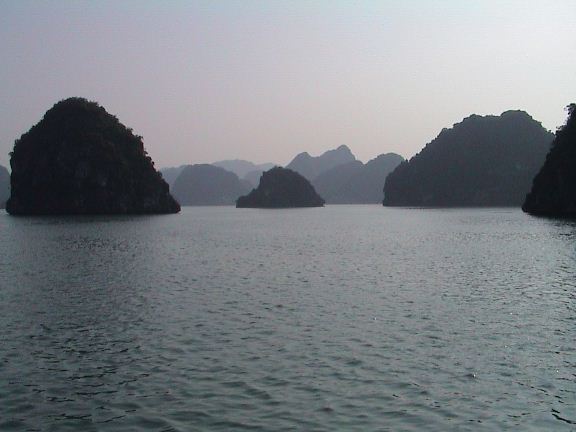
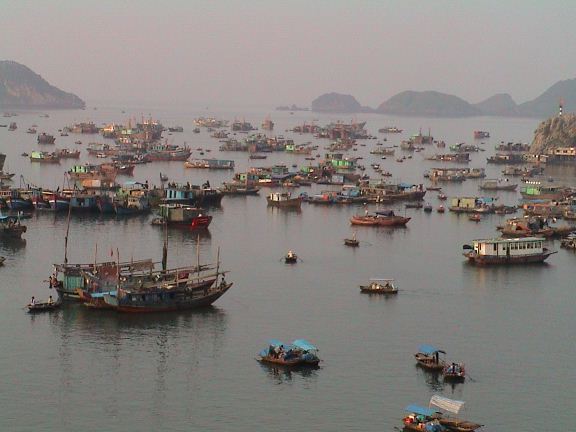 This was the view from our balcony at Cat-Ba Harbor
in HaLong Bay, a busy fishing village that also played host to the famous
limestone islands known as Halong Bay. We were taking the economy Sinh
Cafe trip which cost us $52 total for 3 days and 2 nights but which unfortunately
had some shortcomings where the hotel was concerned. Tiny room, tiny towels,
no soap, rabbit ear TV (which included one French language channel), and
a spartan breakfast of egg
,
bread, butter (but no
jam) and coffee. Because of the world situation we found ourselves ever
hungry for and yet depressed by world news. We complained of news overload
when we had CNN but also complained when we didn't have it.
 On our bus ride to Halong Bay we met some interesting people, young
and old. In addition to a student from the University of Edinburgh, and
another from Belgium, we met The Spaniard. He was about 45, had wild black
shoulder length hair, rolled his own cigarettes and walked with a limp from
an old accident. All he needed was an eye patch and he would have been the
perfect pirate! We could imagine him on his pirate ship, hiding out among
the scattered islands.... But in reality, he was a very gentle, quiet man.
One day we took a boat trip to Monkey Island, and enjoyed both the monkeys
and the water there. As we passed some of the little villages, we noticed
that many of the boats, large and small, were made of woven palm leaves
covered with pitch. In fact, many of the upper portions of the house boats
were made in the same way. Sadly, as beautiful as Halong Bay is, there is
a problem of air and water pollution that screams for attention. Vietnam
will need to give this serious attention in the future or it will have a
diminishing tourist attraction on its hands.
 The next excursion from Hanoi was to the hill tribe country of Sapa
and Bac-ha. This proved to be a memorable train journey as we learned about
the night train and "soft" and "hard" sleepers. This was a 10 hour train
excursion from Hanoi, starting at about 7 pm. Though we thought we were ready
for the wily ways of pick-pockets we were out-witted. First, the hard sleeper
is just what it sounds like, a hard bunkbed surface to lie on,
though our hotel staff had graciously arranged to have us take foam mattresses
to lay on top to cushion the surface. This proved invaluable for our older
bones. As soon as we arrived at the train station, we were greeted by young
men eager to help us find our berth. Though I anticipated this would in the
end cost us something I was unprepared for how much. After repeatedly grabbing
at my ticket and bags to "help" me I was finally led to the proper berth.
Tina and I were joined in the small compartment by our two friends who kept
"helping" us and trying to sell us water and snacks. They created such a
commotion and distraction that I did not notice at exactly which moment my
train ticket disappeared. Tina, thinking on her feet, finally pushed them
out of the compartment and closed the door behind them. It was not until we
had some peace and quiet that I realized my train ticket had disappeared.
The next couple to join us in our compartment were accompanied by a Vietnamese
guide, fluent in English, whom I explained my plight to since the conductor
spoke no English, though we later learned was excellent at pantomiming instructions
for the window, air-conditioning, and water. The guide took our problem to
the conductor who was obviously quite annoyed at me for allowing this to happen
and informed us that I could keep my berth but would have to pay for the
ticket again. But just minutes later, the guide returned to our compartment
to inform us that "someone" had found our ticket outside on the ground but
that they wanted a reward of 50,000 dong. I was advised that it was better
to pay the reward rather than 5 times that amount to buy a new ticket. When
I went out to claim my ticket and pay the reward who did I see but the same
young man whom we had just thrown out of our compartment who was shouting
and carrying on, seemingly upset that someone may have accused him of stealing
the ticket. It seemed we slept very little but were exhilarated to arrive
in Sapa and then took a shuttle to our hotel. We immediately headed off to
a local tribal village called CatCat village. Along the way we ran into a
young couple traveling from Israel. We seemed immediately attracted to one
another, perhaps because of shared experiences with terrorism and a certain
political isolation. They were a delightful couple who had a lot of traveling
experience and we talked for a long time on that grassy hill. We shared travel
stories and consoled one another about the horrors of terrorism. They were
the first people we met with whom we felt we could freely talk to about the
events of Sept. 11, and it helped us feel a little less alone in Asia.
 We also ran into a few entrepreneurs from the local Hmong tribal
village. They were all determined to sell us something and we couldn't decide
who to buy from so we decided to buy a pillow cover from each of them--all
at the same negotiated price. This was acceptable to everyone. We continued
to see these children everyday while we were in Sapa and ended
up purchasing not only pillow covers, but friendship bracelets and mouth harps.
Saturday and Sunday were the big market days in Sapa, when tribal people
came from miles around to buy supplies, visit friends, and for young sweethearts
to meet. All were dressed in traditional clothing and the atmosphere was
of a time in the distant past. The smell of incense and smoky fires filled
the air. The chatter of gossip and bartering and the sweet, high-pitched
voices of the tribal women singing was of another innocent world.
 While we were in Sapa we decided to take a one day excursion by
Russian jeep to the northern boundary of Vietnam where you could actually
see the Chinese boundary. We had heard of Bac-Ha which was famous for its
Sunday market which attracted villagers from various tribes in the vicinity.
Each tribe has a distinctive style of dress and headgear which are usually
quite colorful. The women, as a rule, are much more colorfully dressed than
the men
.
We went by jeep and with a guide and fortunately so
because the roads were treacherous. The picture at right was the main thoroughfare
of this village--used by buffalo and humans alike. The children tend to the
buffalo here and in most villages--notice the girl hopping on the back of
one buffalo to catch a ride.
 We were invited into the home of this family as we were walking
through the village. Inside, we sat on tiny stools, no higher than four
inches off the ground. The floor was hard packed dirt which was gently rippled
with age and polished smooth by bare feet. The sleeping platform for some
of the family was in the corner of the main room and raised off the floor
about two feet. In rafters above, ears of husked corn were stacked to dry,
and massive woven baskets held the rice. There was a fire pit in the main
room, but cooking was done in another room of the house. It was fairly dark
inside, and lanterns were used at night. With our best efforts at sign
language we managed to share an animated and fascinating "conversation."We
learned that we parents were all about the same age, and I decided to bring
out our family pictures to share, which was an instant ice breaker! While
at first we sat only with the father of the family, when the pictures came
out, the mother, daughters, son and women friends were crowding around for
a look. We gave the father and mother reading glasses we had brought and
explained what they were for, and how we too, needed them! We gave the children
pens, pencils note pads, and safety pins , as we had heard these were useful
gifts. Before we were done, the head of the household brought out a bottle
of "home brewed rice liquor" and proceeded to refill our glasses repeatedly
and even offered the rest of the bottle to take with us when we had to go.
 Everywhere we went, everyone, old and young , was curious and most interested
in seeing our family pictures. These children wanted to know who each person
was, and what their relation was to us. Somehow, with animated sign language,
we were able to point out our son, daughter and parents so that they understood.
They would laugh when they recognized Dale or me in the picture, Clearly
pictures of any kind were a novelty.
 This is a picture of a group of lovely Flower Hmong girls at the
large market in Bac-Ha. They are listening to a series of home-made tapes
of tribal songs for sale. In the market, we virtually disappeared among the
masses of local people crowding their way through the narrow aisles. The
smell of smoke, roasting meats, incense, tobacco and humanity swirled through
the warm air. The sounds were of gentle voices bargaining, animated greetings
among friends, babies occasionally crying and the favorite tunes played on
tape players. Many tribes from all over came to this weekend market. Some
brought clothing, textiles, jewelry, baskets, food, produce, animals, what
ever they had to sell. Others came to buy supplies and all came
to socialize. There were plenty of food stalls, and even a hooka stand for
a smoke! Part of the market area had a roof structure, but the
rest was strung with ropes and plastic sheeting to protect from rain. The
tribal people are very petite, so the head clearance was about five feet
or so. Tall visitors like Dale kept having to duck down, or get tangled in
everything. Ah, I'd found my people! I never had to duck. Below
the main market was one of two areas devoted to livestock
.
. Buffalo,
goats, pigs, sheep, dogs, ducks and chickens were bought and sold here. To
one side there was a blacksmith, clanging away, working with iron. Huge woven
baskets, six feet in diameter and four to five feet deep were also for sale.
In an upper field, horses and donkeys were traded. This was market
day in Bac-Ha.
 The trip to the Perfume Pagoda was a one day excursion out of Hanoi,
partly by bus and partly by sampan. We were rowed for perhaps an hour through
this enchanting rural countryside. The limestone rock formations were similar
to those in Halong Bay except not set on water. We had arranged a Sinh Cafe
trip and our guide for the day was very knowledgeable, spoke English quite
well and was eager to fill us in on the history of Buddhism in Vietnam.
We were told that this pagoda was the most famous in all of Vietnam and
people journeyed from all over the country and Asian region to venerate
the Buddha here especially during the festival months of March and April.
The Perfume Pagoda gets its name from the plumeria trees which scent the
air. After we disembarked from our sampans we walked up a long wet, rocky
path for another hour before reaching the grotto where the pilgrims
come to worship. Our guide demonstrated "how" to pray at a Buddhist temple
or pagoda and now we can do a pretty good job of looking like we know what
we're doing. Meanwhile, I have been reading up on Buddhism, thanks to a
book that Mary Ann, one of my work colleagues gave me just before we left.
Buddhism is hugely important in Vietnam as well as many of the other countries
in Asia that we will be visiting.
 The ancient city of Hue was the next stop in our journey after
leaving Hanoi. We had looked into the prospects of taking what is known
as the Sinh Cafe Open Tour Bus which runs from Hanoi to Saigon with several
stops along the way and permits you to get on and get off according to your
own schedule. This permits for a leisurely or spontaneous change of plans--just
the kind of trip we wanted to have. But the first leg of the trip from Hanoi
to Hue was a killer of 14 hours in a bus which we decided to forego and
take by plane. We booked the bus tour to start in Hue and continue down to
Saigon, with stop overs in Hoi An and Nha Trang. Hue was the capitol of all
of Vietnam from 1802 till 1945 when the last emperor, Bao Dai abdicated
his throne and retreated to France. The French were already very active
through the missionaries in the early 1800's and the influence is clearly
felt in this city of Hue. But also is felt the Chinese influence. We had
a one day whirl-wind tour of the city, escorted by a Vietnamese guide who
was very fluent in English, having been to the US and Canada several times.
She provided us an interesting glimpse into modern day Vietnamese life through
the eyes of someone who was quite ambitious and frustrated by what she was
confronted with. She told us that most of the jobs in Hue were government
jobs and that there was actually very little work to do. She worked in urban
planning but had previously been a government tour guide. She was called
up to be our tour guide as a "side job". Because there was so little work
to do at her regular job she had an arrangement to take off time when she
wanted to. It supplemented her income and she confided to us that she was
laughing and talking so much more than she would normally do at her regular
job while she was giving tours. She had an 8 year old daughter, a college
degree and was married to a Ph.D. candidate in literary criticism. She had
been to North America several times including a two year stay in Canada somewhat
recently. This had clearly been a source of tension and conflict with her
husband. She told us that they hadn't talked in several days after an argument
over the World Trade Center bombing and American reactions to it. She apparently
voiced sympathy with the US and her husband accused of being changed by her
stay abroad. She went on to say that Hue was the wrong place for her to live,
that she needed a city like Saigon, more open-minded where a woman could
start a business. In fact, we talked at one point about various business
ideas and marketing strategies and she was very eager for our ideas. She
was a fount of knowledge also about the history of Hue and the sites we went
there to see. She told us that she very nearly got to be the tour guide
for Bill Clinton last year but due to the bad weather in Hue, his itinerary
changed and bypassed Hue. The picture above is of one of several mausoleums
for emperors which we visited. This mausoleum was built to hold the remains
of Emperor Khai Dinh. It was built between 1920-31 and I'm standing amidst
his mandarins in the courtyard. It was really quite ornate and, as you might
expect, reflected heavy French influence inside in the mosaic work.
 The first leg of our bus tour took us from Hue to Hoi An. This is
a view of the Thu Bon River from the center of old Hoi An. This beautiful,
ancient city dates back to the sixteenth century as a center for trade between
Europe, China, Japan and Vietnam. Notice the eye on the bows of the boats?
We understand this is to guard against evil spirits. These eyes are also
found over the entrances of many buildings in town, for the same purpose.
Today, tourism is one of the most important sources of income for the people
of Hoi An. If you want a suit or dress custom made, you have many dozens of
tailor shops to choose from. In fact, we didn't see how all of these shops
could stay in business, there were so many.
 This is the Chinese Assembly Hall. It was built in 1776 as a meeting
place for the numerous Chinese merchant families living in Hoi An, as well
as a place of worship. There are also quite a few homes and businesses dating
from the mid seventeenth century on, that are constructed of teak wood,
and largely unchanged in appearance. Some descendants of the original families
still live in these buildings! We rented bicycles to get around town, and
they worked very well, since the streets were quite narrow, and there were
almost no cars. During the heat of the day, the town was fairly quiet. But
at night, when it cooled down, the streets came alive. Food stands and many
shops opened up, with their proprietors standing in the doorways, inviting
every passerby into their stores. The narrow streets were teeming with pedestrians,
dogs, bicycles and motorbikes. Hoi An was one of the prettiest little towns
we visited in Vietnam.
We left Hoi An on the Sinh Cafe overnight bus for Nha Trang. We were
told we would be able to sleep in our seats, and it wouldn't be too bad......WRONG!
We started out on our 12 hour journey with high hopes, as each of us had
a double seat. Quickly it became apparent we had a pair of characters for
drivers. With numerous no smoking signs posted, our driver made it quite
clear he was a chain smoker. He would open his side window every time he
lit up, which was every hour like clockwork, effectively spreading his massive
tobacco cloud evenly throughout the bus. The next thing we discovered was
that he liked to drive FAST. The roads in that area are riddled with massive
pot holes, and there were construction projects all along the way. Add to
that the large amount of traffic in the form of other trucks and busses,
cars, bicycles, horse drawn carts, pedestrians, dogs, chickens, etc....You
get the picture, it was an obstacle course. Our driver drove as fast as he
could until the moment before impact, then he'd slam on the brakes and swerve,
just missing his target. We would be thrown to the left, thrown to the right,
slammed against the seat, then dumped towards the floor. And this went on
for 12 action packed hours! We were quickly reduced to a pathetic state of
tortured insomnia, knowing there was nothing we could do. But for me and
the rest of the women on the bus, it only go worse. As a result of the French
occupation, there is one word every person knows, and that is "toilet". Several
hours into the trip, the bus stopped and both drivers left the bus and relieved
themselves in the road next to the bus. I don't mean in the bushes, which
is common, but right out there with all the headlights illuminating every
detail of the event for all to see. When we told the drivers we needed the
"toilet", they smiled and motioned for us to go out in the street too! One
brave, desperate young woman managed it, but the rest of us refused. So,
off we roared into the night, our well relieved, nicotine saturated drivers
in a total control. Several requests for a "toilet" were brushed aside with
the promise to stop "soon". An eternity later, we did stop, at our drivers
favorite noodle stand, where his apparent girlfriend worked. We asked in
utter desperation where the "toilet" was and were directed to the dark recesses
of the junkyard out back. Some never found it in time....
 At long last our tortured, sleep deprived bodies were dumped
in Nha Trang. It was early in the morning when we checked into our hotel,
and overheard the announcement of a bus leaving for the docks. At the docks
were the fleet of boats taking people out for snorkeling day- trips.We
were beyond tired, but decided to charge ahead and make the most of the
day. We chose a day- boat trip with Papa Hahn, and that's where we met Vinny,
the Disco Dance Instructor, aka Lehmo, the stand-up comic, from Australia.
Lehmo was great fun, and his favorite shirt obviously helped get everyone
in the mood. Look at this boy, he does have a good sense of humor, doesn't
he?....!Our memories of the night before started melting away. We soon found
out we had chosen a party boat with Papa Hahn, aka "Strong Man" as our captain
and principle leader. He fed us, took us snorkeling, then the party began.
People were soon diving off the upper deck of the boat like lemmings into
the sea. With an inter tube rigged up as a floating bar, and "Strong Man",
in his leopard print bikini sitting in it's center, everyone was soon floating
in their own inter tubes, sipping plum wine, listening to crackling rock
'n roll. One of our fellow shipmates, a self described world traveler and
sculptor, shared with us that it was his birthday, and proudly
and repeatedly announced "Everyone drink, the drinks are on me!" That was
enough for this group. Soon we were singing "national anthems" and bar room
favorites of every country represented there, lead perfectly by "Strong Man".In
the end, all of us were bonded by our lack of sobriety and matching sun
burns. It wasn't planned, but it did more than make up for the night before!
On October 19, we boarded our bus for Saigon, or to be PC,
Ho Chi Minh City. Just outside the city, we passed miles of rubber tree
plants, part of a very large plantation. Each large tree had spiral cuts
in the trunk and a small bucket mounted at the end, to catch the sap. It
was the largest single agricultural project we saw. Attached to it was a
massive fenced area earmarked for industrial development, though mostly
open fields at this point. We arrived at our Sinh Cafe bus stop about 7pm
in the downtown area. Everyone grabbed their backpacks and bags and made
their way to their hotels in the area, through the crowds of hawkers, local
people and mud. We had two possible choices for a hotel, so with Dale watching
our bags, I darted off to check both of them out. The Hong Kong family hotel
was the best and became our final home in Vietnam. The owner worked for the
US during the war, and the whole family was very friendly to us as well as
everyone else who stayed there. For about $11 we had a large air conditioned
room with hot shower, and full breakfast. Outside though, it was very different.
Many cyclo owners would park their precious vehicles across the alley at night
and sleep in them until morning. We found out they were very poor and from
the country, with no place to sleep in town. And even more disturbing were
the number of homeless children roaming the streets, with no apparent government
help whatsoever. This was just heartbreaking. We took a cyclo to the heart
of the city and saw the famed Rex Hotel, a favorite haunt of journalists
in the sixties. Next was the Art Museum, which was housed in a magnificent,
French style mansion built by a Chinese merchant at the turn of the century.
 There were artifacts from the tenth century on, including this Buddha.
One interesting note, was the lack of identification and description of displays
in the English language. Most foreign visitors we saw spoke some English,
as did many of the people of HCM City. A lack of resources for the museums
must, no doubt, be the cause. Vietnam did have a rich, magnificent culture
at one time. Daily life in the city began at 5am, with a bustle of people
setting up food stands, and everyone grabbing a quick bowl of rice or noodles
and favorite toppings. In the heat of the afternoon, many would slow down
for a leisurely lunch break. Then at about 2pm, it would all start
again, and go until late in the night. As our time in Vietnam
came to an end the impression left was one of a people challenged with significant
poverty, and at the same time a driving determination to develop
its way into a modern south-east asian nation. Trade representatives are
constantly coming to Vietnam from all over the world and recently passed
legislation in the US will open the door to more trade with us. Though sad
to be leaving Vietnam, we were keenly looking forward to the next leg of
our journey, the Kingdom of Thailand.